
Oxidation of Alkynes with Ozone and KMnO4
- As we’ve seen previously, alkenes (olefins) can be oxidized to carbonyl compounds (aldehydes, ketones, carboxylic acids) with ozone and KMnO4. (See article – Alkene Reactions – Ozonolysis)
- Alkynes can also undergo oxidative cleavage with ozone and KMnO4.
- The products depend both on the structure of the alkyne and the reaction conditions.
- With internal alkynes R-C≡C-R , ozonolysis (or KMnO4) gives two carboxylic acids, R-CO2H.
- With terminal alkynes, R-C≡C-H, ozonolysis produces a single equivalent of carbon dioxide (CO2) and a chain-shortened carboxylic acid.
- Additionally, reaction conditions can be modified such that C-C bond cleavage does not occur and 1,2-diketones are formed.
Two oxidation reactions of alkenes that do not translate well to alkynes are the reaction of alkynes with OsO4 (dihydroxylation) and epoxidation with peroxyacids (e.g. m-CPBA). While alkynes do react with these reagents, the reaction products are complex, and we will not dwell on them except perhaps to gawk at the results in the footnotes at the bottom of this article.
[summary image]Table of Contents
-
- Oxidative Cleavage of Alkynes via Ozonolysis (O3)
- Oxidative Cleavage of Alkynes with KMnO4
- Formation of 1,2-Diketones From Alkynes
- Notes
- Quiz Yourself!
- (Advanced) References and Further Reading
1. Oxidative Cleavage of Alkynes via Ozonolysis
- We’ve seen that alkenes (olefins) can be oxidized to carbonyl compounds (aldehydes, ketones, carboxylic acids) with ozone and KMnO4. (See article – Alkene Reactions – Ozonolysis)
The next logical question is: what about alkynes? Can we cleave them too? Not that you’d really want to in most circumstances, saying as alkynes are a wonderful blank canvas for organic synthesis and can be turned into a huge array of useful functional groups…. but if you had to, could you?
It turns out that the answer is yes!
The products that are obtained depends on the structure of the alkyne and the reaction conditions.
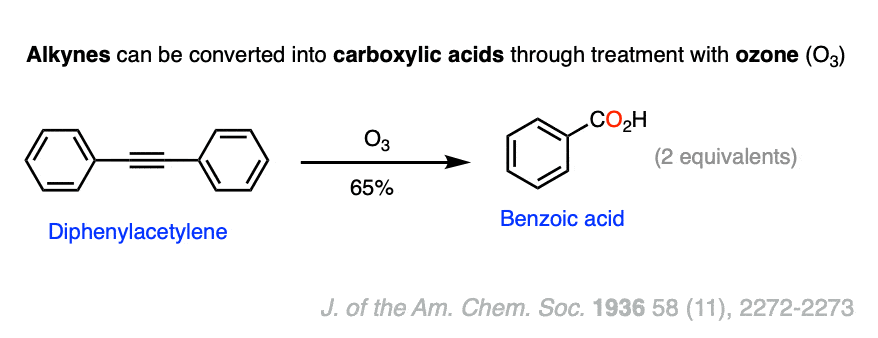
Internal alkynes, R-C≡C-R , can be cleaved via ozonolysis to give carboxylic acids. When the alkyne is symmetrical, this gives two identical carboxylic acids.
A prime example is the ozonolysis of diphenylacetylene, which gives benzoic acid.
Terminal alkynes, R-C≡C-H, also undergo oxidative cleavage. In this case, the terminal carbon bubbles out of the reaction mixture as carbon dioxide (CO2) and we are left with a chain-shortened carboxylic acid.
For example, 1-hexyne becomes pentanoic acid plus carbon dioxide:
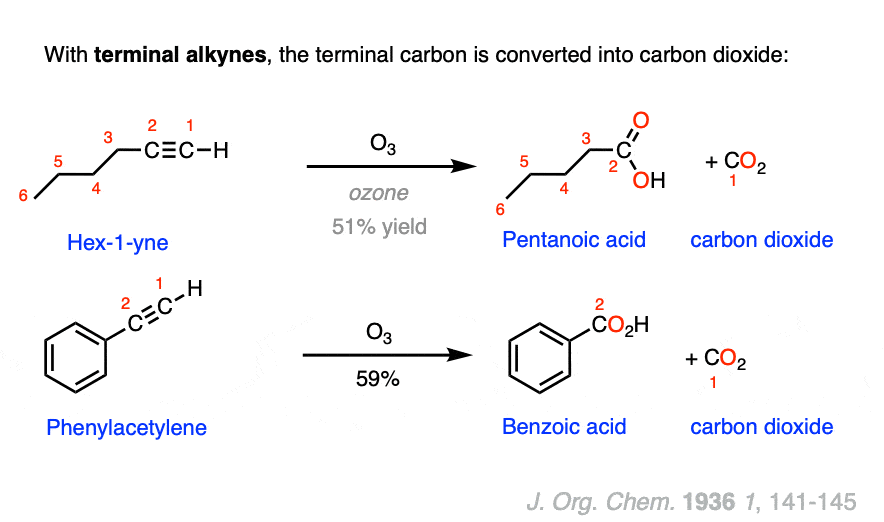
The original product of ozonolysis would be formic acid, HCO2H, but in the presence of ozone the C-H bond is oxidized further to give carbonic acid, CO(OH)2 . Whether during ozonolysis or in a open can of Diet Coke, carbonic acid is in equilibrium with CO2 and H2O, and gradually CO2 is lost to the atmosphere.
2. Cleavage of Alkynes With Permanganate (KMnO4)
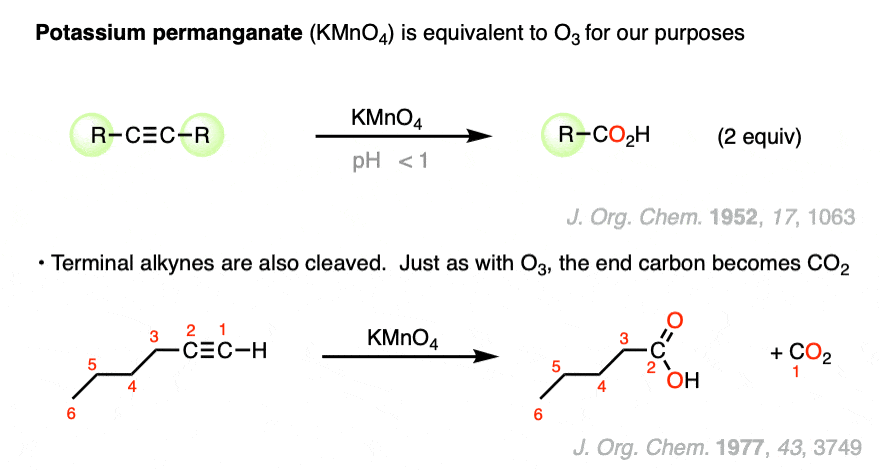
Under certain conditions potassium permanganate can also cleave carbon-carbon triple bonds.
For example, it is reported that KMnO4 under either strongly basic or strongly acidic conditions will break apart internal alkynes to give carboxylic acids.
As with ozonolysis, terminal alkynes are converted to the chain-shortened carboxylic acid and one equivalent of CO2.
3. Formation of 1,2-Diketones From Alkynes
As noted previously, forming carboxylic acids from alkynes, while occasionally useful, seems like a waste of two good C-C pi bonds that could otherwise be converted into something more interesting.
Thus, I am happy to report to you that under certain condtions, C-C triple bonds can be directly converted into 1,2-diketones.
Here, for example, is the reaction of phenylacetylene with KMnO4 to give benzil.
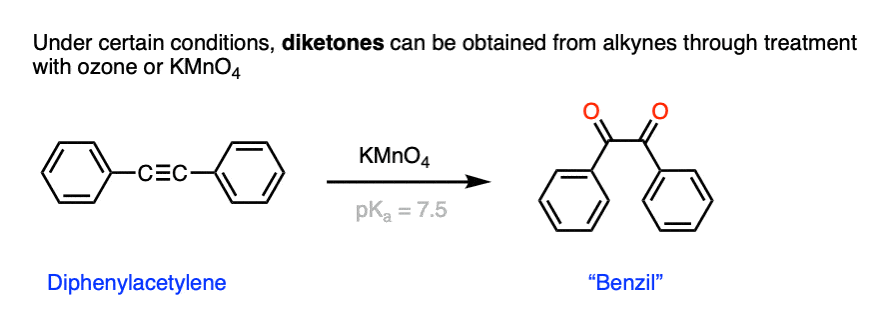
A number of other oxidants (e.g. RuO4) can also carry out this conversion, as does OsO4. [Note 1]
Notes
Some highlights from chapter 13 of Patai’s “Chemistry of Triple Bonded Functional Groups” Part 1, supplement C.
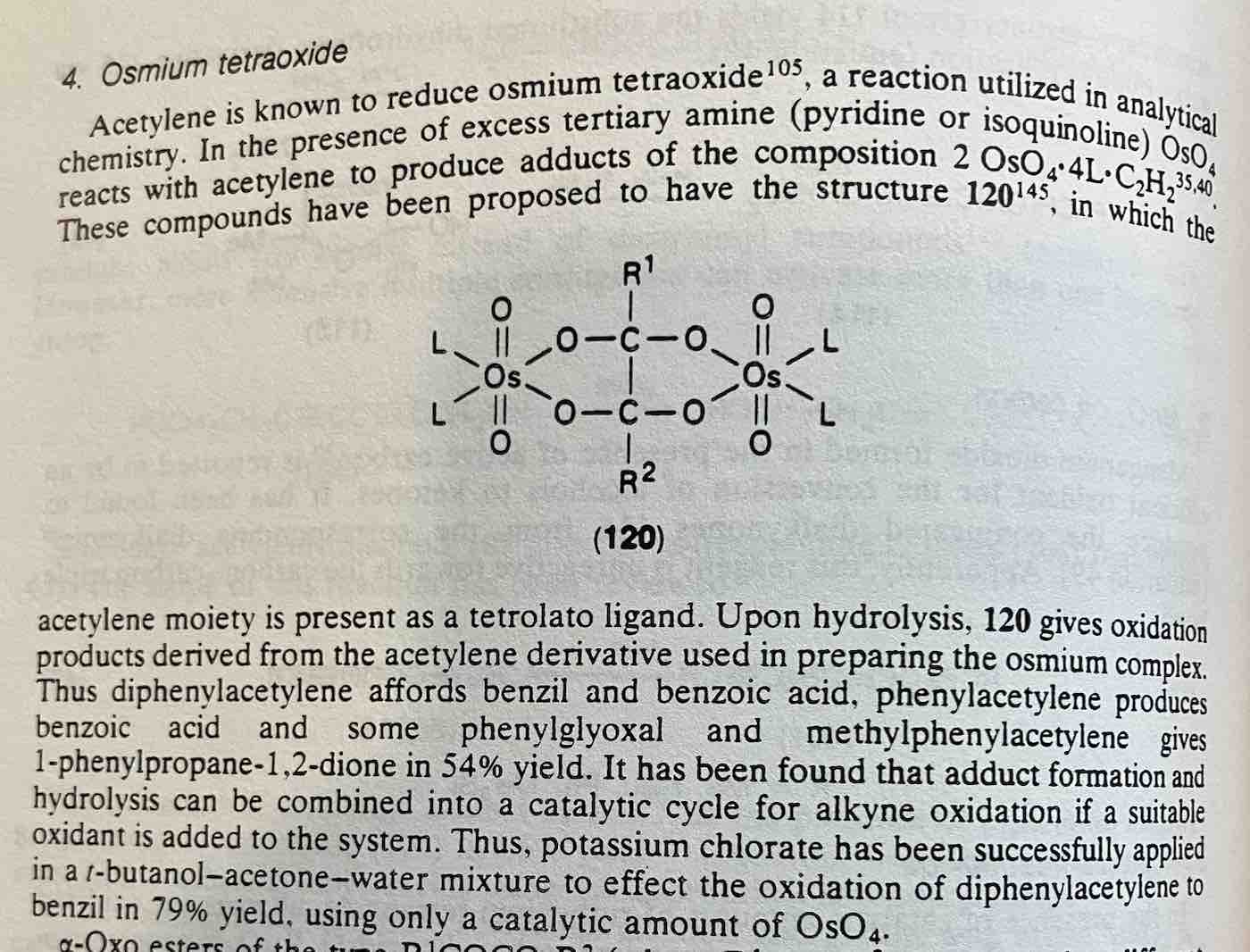
Note 1. On OsO4. Here’s what can happen if alkynes are treated with OsO4. They perform double addition (note that this is a proposed structure, not a conclusive proof) which can then be hydrolyzed to give a diketone.
Note 2. The reaction with m-CPBA is even more interesting. Epoxidation of an alkyne gives rise to a transient, very unstable (due to antiaromaticity – see Antiaromatic Compounds And Antiaromaticity) oxirene, which quickly rearranges to an alpha-keto carbene. The carbene can then perform C-H insertion reactions on adjacent alkyl groups, such as t-butyl.
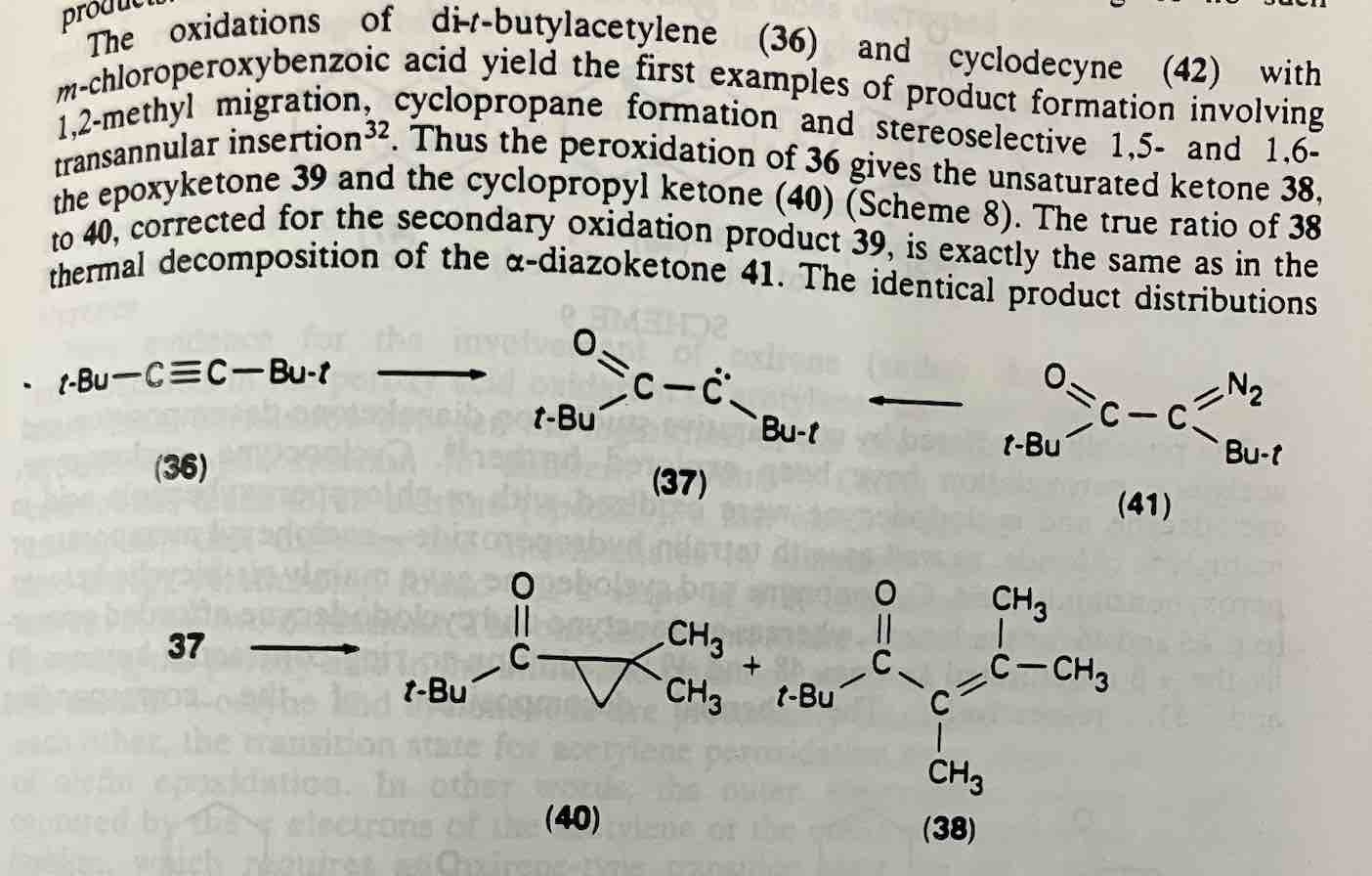
Reactions with cyclic alkynes are even more wild, with transannular C-H insertions to form various bicycles. See JACS 1973, 95, 3284.
Quiz Yourself!
[quizzes](Advanced) References and Further Reading
Ozonolysis of alkynes is not commonly performed and tracking down good examples required more than the usual amount of detective work.
Good leading reference is in Patai’s Chemistry of Triple Bonded Functional Groups” Supplement C Part 1 chapt 13, p. 523-524. (Laszlo I. Simandi).
- THE OZONIZATION OF TRIPLE BONDS CHARLES D. HURD and ROBERT E. CHRIST The Journal of Organic Chemistry 1936 01 (2), 141-145 DOI: 10.1021/jo01231a002 One of the first published studies of the ozonolysis of triple bonds, with yields in the 45-60% range.
- Transformations of alkynes to carboxylic acids and their derivatives via CC bond cleavage Shivalinga Kollea and Sanjay Batra Org. Biomol. Chem., 2016,14, 11048-11060 DOI: 10.1039/C6OB01912A A historical review on carbon-carbon triple bond cleavage and reactions, including ozonolysis, KMnO4, and many other reagents.
- The Isolation of 1,2-Diketones from the Ozonization of Disubstituted Acetylenes Thomas L. Jacobs Journal of the American Chemical Society 1936 58 (11), 2272-2273 DOI: 10.1021/ja01302a053
- Ozonolysis of Unsymmetrical Acetylenes PHILIP S. BAILEY, YUN-GER CHANG, and W. W. L. KWIE The Journal of Organic Chemistry 1962 27 (4), 1198-1201 DOI: 10.1021/jo01051a017
- Ozonolysis of Alkynes—A Flexible Route to Alpha-Diketones: Synthesis of AI-2 Joshua L. Alterman, Dua X. Vang, Marissa Roghair Stroud, Larry J. Halverson, and George A. Kraus Organic Letters 2020 22 (19), 7424-7426 DOI: 10.1021/acs.orglett.0c02182 A relatively recent application of alkyne ozonolysis, to obtain 1,2-diketones.
- Reductive trapping in the ozonolysis of diphenylacetylene S. Jackson and L. A. Hull The Journal of Organic Chemistry 1976 41 (20), 3340-3342 DOI: 10.1021/jo00882a037 The authors study the ozonolysis of diphenylacetylene and propose a mechanism for the formation of carboxylic acids similar to that for the ozonolysis of alkenes.
- Ozonization and Oxidation of Stearolic Acid to 9, 10-Diketostearic Acid N. A. Khan and Melvin S. Newman The Journal of Organic Chemistry 1952 17 (7), 1063-1065 DOI: 10.1021/jo50007a024 This study by Melvin “Newman Projection” Newman shows that actylenes can be oxidized to diketones at mildly basic pH (7.5) but will be cleaved to diacids at either strongly acidic or strongly basic pH.
- Potassium permanganate oxidations of terminal olefins and acetylenes to carboxylic acids of one less carbon A. Paul Krapcho, James R. Larson, and Joyce M. Eldridge The Journal of Organic Chemistry 1977 42 (23), 3749-3753 DOI: 10.1021/jo00443a026