
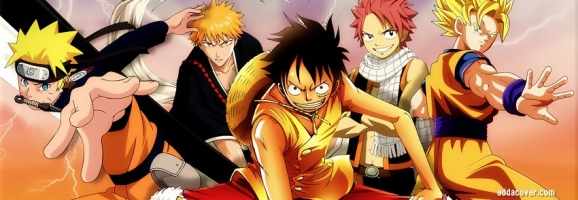
I was first introduced to anime when I was in sixth grade when I turned on the famed Toonami block of Cartoon Network and began watching Naruto. It was a short lived hook for me, because when I began discussing shows I liked with a couple other sixth graders Naruto entered the equation and I was quickly ridiculed. I never understood why I was made fun of or why a show I liked a lot was called stupid, but I stopped watching it anyway, just out of the negativity people seemed to have for it. At the time, I thought that was the end of my anime watching days.
I was reintroduced to anime in high school through some of my newfound friends, who were also avid watchers. At first, I was wary of starting up a trend that I got made fun of earlier in my life, but when I tried again, this time with the hit Black Cat, I was hooked for good. My horizons expanded on the anime front with Fullmetal Alchemist, Baccano, One Piece, Bleach, Fairy Tail, Soul Eater, and a comeback of Naruto. And through anime, I found a love of manga, the Japanese cousin to our comics. Though I had to continually defend my fondness for Japanese animation to some people, others were perfectly content with my choice of media.
Still, it stuck oddly in my head why some people were so against this unique and fun form of animation, especially when American shows such as Teen Titans and Avatar: The Last Airbender had many anime similarities. It was even more peculiar when Pokemon and Dragon Ball Z were immensely popular, as well as the Oscar-winning movie Spirited Away, even though they were from Japan. Somewhere, there was definite disconnect.
Anime was introduced to America in the 1960s via Robotech and Astro Boy, the latter which became an American feature film in 2009. Anime continued to crop up sporadically throughout the 70s and 80s, and didn’t gain a major foothold until the 90s. During the 70s and 80s, anime had gotten a bad name. This mostly this stems from the cultural divide. Anime has frequently been more violent, sexualized, and suffers greatly from a language barrier and different culture..
Anime in America took its real big hit by the Action for Children’s Television, or ACT, not to be confused with the standardized test of the same name. It moved to censor anime on multiple platforms, including “material containing homoeroticism, gender ambiguity, or anything that suggested the main protagonist was not one hundred percent ‘good-guy material,’” (Chambers, 96). Anime protagonists are rarely as clean cut as many American heroes. Many have complicated back stories that reveal their sometimes amoral motives, and “often [have] vices, thus making them human,” (Chambers, 96). In anime, the characters aren’t always about being a hero, but about being human.
One of the biggest criticisms of anime has been the extensive violence it contains. Many of the most popular animes that have reached America are fighting focused, not that terribly different from some American cartoons and live action shows. However, the violence can sometimes be graphic with spurts of blood and gore and interspersed with swear words and violent dialogue. And at various times, a fight ends with one character, usually the villain, dying. In a research paper, it was stated, “The Japanese acknowledged that death was a part of life by occasionally allowing characters to die,” (Chambers, 96). This allowance of death states that the characters are not immortal, a concept that American shows are prone to, and it keeps tension with the audiences, because they never know who will win.
This amount of violence is another part of the cultural divide. Japanese culture is more accepting of violence, as stated in a New York Times article, “the public’s tolerance for blood and guts on TV has traditionally been much higher than it is in the United States,” (Rutenberg). Many anime have short spurts of high intensity violence, usually only lasting a couple minutes of the programming, then switches back to dialogue. This is frequent in many of the popular animes that have reached the United States, where the comedies, dramas, sports adventures, and romance genres, which are usually devoid of violence, never make it to a programming block.
Another criticism of anime has been the sexuality involved with characters. Anime sexuality appears in two parts: nudity and clothing of the characters, usually associated with female characters, then the actual sexual orientation of a given character. Various female characters are portrayed as “necks are thin, the heads are big, the breasts are big, and the hips are small,” (Geary), and sometimes seen with skimpy clothing, and the male characters are usually heavily muscled and handsome. This has been the stereotype for Japanese anime, drawing the ire of Americans. The belief is that all anime is about long-legged, big-breasted women, when this isn’t the case. In most animes, if they have a character like this, there is normally only one and usually is portrayed as the most knowledgeable person in the world. Good examples of this are Nico Robin from One Piece, Rinslet Walker from Black Cat, and Tsunade from Naruto. When this isn’t the case, this type of character is the comic relief, albeit in a raunchy way.
Nudity is also an issue frequently brought up when discussing anime. It is no surprise that nudity in a cartoon is an issue, signally similar issues in American shows. The nudity expressed in anime was deemed pornography and therefore banned on principle. However, this anime porn was given a name, hentai, which is extremely violent and pornographic. In a research paper it stated, “violent actions that gave the entire anime genre a negative stereotype,” (Chambers, 95). In 90s, hentai was instrumental in giving anime a bad name because of its violence and pornography. Though anime has managed to distance itself from hentai, it still brings up questions about the genre itself.
The second part is the sexual orientation of a character. The Japanese like to play with gay, lesbian, and bisexual relationships, and a popular genre in anime is the “gender bender,” where a person’s gender is swapped. Until recent years, any anime with characters that are not straight, or have ambiguous genders, have been under scrutiny by Americans, and are rarely aired. This is another cultural divide issue. The Japanese are more relaxed about relationships that are not devotedly straight, and are aware that is simply a part of life. Americans tend to be more uptight about showing these types of relationships to audiences, especially when many anime were reaching younger viewers.
Last is the language barrier. All anime are originally in Japanese, which means that when they arrive in America, studios must remove all the dialogue and write similar sounding dialogue to replace what they had. This garnered criticism on several different platforms, one of the first being swear words. Some anime, especially the fighting oriented ones, are mingled with curse words, ‘damn, hell, and bastard’ being the most frequent. The use of profanity angered many viewers with young children, causing yet another rift in the anime name.
Another language barrier issue, this also stemming from the cultural divide, was the Americanization of Japanese culture. Due to anime being from Japan, much of the dialogue is meant for Japanese audiences. Studios would change the animation itself to fit American standards, as well as names, places, and food. This sometimes was minimal, but others it was huge, as in Pokemon, where all of the characters were given American names and the Pokemon themselves were renamed. Studios would “Americanized beyond recognition with infelicitous dubs, American names, and sometimes, mangled plot lines,” (Chambers, 96). This became an issue with some audiences, because they viewed it as censorship. The Americanization of anime sometimes, “alter[s] plot lines to make them more socially acceptable to Western audiences,” (Chambers, 95).
This Americanization of the culture created fansubbing. Fansubbing is “the practice of taking the original Japanese anime and translating it word-for-word in fan-made subtitles,” (Chambers, 96). Fansubbing became increasingly popular when very little anime was making it to American, but anime still had a relatively large fan base outside of Japan. The use of fansubbing allowed the circumvention of the Americanization dub or subtitle process. Fans would be able to get the same message across without compromising the storyline.
Anime has an interesting history with Americans. Over the years, it has taken a beating simply for being what it is. It was attacked because it’s a cartoon and cartoons are thought to be for kids. But without anime, shows like Family Guy, Futurama, and Robot Chicken wouldn’t be around. Recently, anime has taken a comeback and the name isn’t being as tarnished as it use to, but it still doesn’t have a good amount of glory as it should be awarded. I enjoy anime, and not because of its violence or sex, but because the characters are fun and relatable, the storylines are engaging, and overall, it’s an art that should be experienced.
Work Cited
Chambers, Samantha N Inez. “Anime: From Cult Following to Pop Culture Phenomenon.” The Elon Journal of Undergraduate Research in Communications 3.2 (2012): 94-101. Web. 7 Apr. 2013.
Geary, Joe. “Young Women (and More) in Anime.” Femspec 2004: 135,139,216. ProQuest. Web. 23 Apr. 2013 .
Harmon, Curtis. “Anime Overly Violent?” Anime Overly Violent? Worchester Polytechnic Institute, 14 Feb. 2001. Web. 10 Apr. 2013.
Rutenberg, Jim. “Violence Finds a Niche in Children’s Cartoons.” The New York Times. The New York Times, 28 Jan. 2001. Web. 10 Apr. 2013.
What do you think? Leave a comment.